
Why Choose Sole Bootlab?
Updated: Apr 29

Why Choose Sole Bootlab?
Because bootfitting is not a buzzword here
Thirty years ago, properly fitting ski boots sounded strange to many people.
Ski boots were mostly sold like products. You chose a size, chose a flex, tried them on, suffered a bit, and accepted that skiing hurt.
Numb feet? Normal. Lost toenails? Normal. Undoing your boots every time you stopped? Normal.
A lot of “normal” in skiing was really just badly understood equipment.
At Sole Bootlab in Chamonix, we never accepted that.
We believed pain had causes. We believed comfort and performance were not enemies. We believed the skier, the foot, the boot, the liner, the shell, the stance and the ski had to be understood as one system.
At the time, that sounded strange.
Now, “bootfitting” is everywhere.
Every shop says it. Every website uses it. Every salesperson has the word ready.
The problem is that when a word becomes popular, it becomes cloudy.
Bootfitting can mean careful analysis, measurement, modification and long-term problem solving.
Or it can mean warming a liner, selling a footbed and using the word “custom” because it sounds expensive.
Those are not the same thing.
Quick answer
Sole Bootlab is not a normal ski shop that added bootfitting because the word became useful.
Sole is a bootfitting lab that sells ski boots because the right boot is part of the solution.
We start with the skier, not the catalogue.
We use experience, measurement, critical thinking, biology, physics, chemistry and engineering to make ski boots work for real people.
No snobbery. No theatre. No “this is what I ski, so you should too.”
Just the boot, the foot, the skier and the job of making the system work.
We are not catalogue people
Ski boot catalogues are useful.
They tell you the official story: flex, last width, weight, liner name, plastic type, skier category, touring range, race DNA, freeride power, progressive response.
Wonderful.
Also, not enough.
Modern ski boots are amazing pieces of engineering. The products are not the enemy. The best manufacturers are doing extraordinary work.
But a catalogue cannot see your foot.
It cannot see your ankle mobility. It cannot see your calf shape. It cannot see whether your heel lifts. It cannot see whether your foot collapses. It cannot see whether your stance is using up all your movement before you even ski.
A catalogue describes the boot.
A bootfitter must understand the skier.
Those are very different jobs.
We can ski. That is not the point.
Let’s be clear.
We are not idiots who cannot ski, hiding behind tools and clever words.
Within our team, there are more than 50 years of skiing, fitting, testing, falling, learning, making mistakes, breaking bones and getting back up again.
We know the mountain.
We know the feeling of a boot that works.
We also know the feeling of a boot that absolutely does not.
But our skiing is not your fitting.
Our favourite boot does not become your boot.
Our skiing style does not become your skiing style.
Our biases do not get to sit inside your shell.
A good skier may understand what works for them, but that does not automatically mean they understand what works for you.
At Sole Bootlab, your anatomy, stance, mobility, skiing, pain, objectives and feedback lead the fitting.
Not our ego.
Not our favourite model.
Not our heroic memories of the best run we ever skied, which were obviously incredible and almost certainly exaggerated.
Bootfitting is problem solving
Real bootfitting is not a sticker on a shop window.
It is not a theatrical performance involving a heat gun, a few tools and some confident noises.
Real bootfitting asks better questions.
Why does this boot work for this skier?
Why does it not work?
Is the problem the shell, liner, footbed, cuff, ankle, calf, stance, size, volume, mobility, or the way pressure is being transmitted into the ski?
Is the boot too stiff, or is the skier badly positioned inside it?
Is the boot too narrow, or is the foot unsupported and collapsing?
Is the boot too big, or is the heel simply not being held correctly?
That is bootfitting.
Not theatre.
Not vocabulary.
Not catalogue poetry.
Our approach is empirical
At Sole Bootlab, we are not interested in guessing beautifully.
We are interested in what works.
Our approach is empirical: observe, test, adjust, learn and repeat.
To fit ski boots properly, you need more than sales language.
You need biology: feet, ankles, calves, tendons, joints, pressure, circulation, mobility and asymmetry.
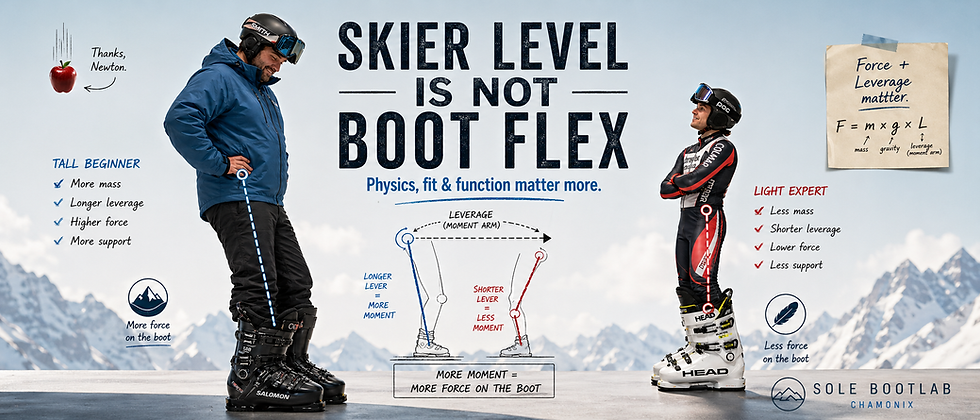
You need physics: force, leverage, torque, pressure, flex, ramp angle, cuff angle, stance geometry and balance.
You need chemistry: plastics, temperature behaviour, liner foams, adhesives, grinding, heating, cooling and material limits.
You need engineering: shell design, cuff mechanics, boot boards, pivots, buckles, liners, tolerances, repeatability and durability.
The engineers who design ski boots work with these realities.
So should the people fitting them.
That does not mean every customer needs a science lecture.
Most people just want boots that work.
Fair enough.
But behind the fitting, there should be a method.
Not folklore.
Not ego.
Not “this is what I ski, so you should too.”
We learned by doing
Sole’s knowledge did not come from reading catalogues and pretending that was expertise.
It came from years of fitting, modifying, testing, failing, correcting and learning.
A long history of success is valuable.
But a long history of mistakes is also valuable, if you are honest enough to learn from them.
That is where real expertise comes from.
Not from never getting it wrong.
From getting it wrong, understanding why, and changing the method.
That is how bootfitting improves.
That is how a workshop becomes a lab.
Sole is bigger than one person
Sole was started by Steve and Seb, but Sole is not one person.
It is not even two people.
It is a way of thinking.
Every winter, seasonal staff join us. Some stay longer. Some move on. That is the rhythm of a mountain town.
But the important thing is not just whether someone can ski, sell, grind a shell, heat a liner or remember the catalogue.
The important thing is whether they can see the problem clearly.
Can they listen? Can they observe? Can they think critically? Can they ask why something is happening, rather than simply repeat what they were told?
Sole continues by finding like-minded people who share the same vision:
Bootfitting is problem solving. Every skier deserves care. The end result matters more than the performance of expertise.
This is why Sole is the important word.
Not one fitter. Not one season’s team.
Sole is the philosophy: a shared refusal to accept mediocrity, a shared respect for the skier in front of us, and a shared love of the moment when the boot finally works.
No snobbery. No hierarchy of smiles.
Sole Bootlab is not an elitist ski shop.
Yes, we work with very strong skiers. We fit elite athletes, mountain people, racers, guides, instructors and skiers who know exactly what they want.
We love that work.
But a beginner’s happy face is worth just as much to us as an elite skier’s approval.
A nervous skier who stops being afraid of pain matters.
A tourist who gets to enjoy their holiday matters.
A child who starts to love skiing matters.
An older skier who can keep skiing without suffering matters.
The joy is the point.
If you need a high-performance boot, we will take that seriously.
If you need your first proper pair of ski boots, we will take that seriously too.
Because the mountain does not belong only to experts.
And neither do good ski boots.
Google can find a shop. It cannot feel the fit.
Google, ChatGPT and every search tool on earth can help you find a visible location that says it “fits” ski boots. After all, is the most common method by which you'll find us in the first instance.
That is useful.
But visibility is not the same as understanding.
A good website, a good map position or a confident description can help you find a place. It cannot tell you whether everyone behind the bench is cut from the same cloth.
We are not all the same.
At Sole Bootlab, your level does not decide how hard we try.
Your budget does not decide whether we care.
Your problem is not “standard” just because we have seen thousands of feet before.
You are not an average. You are not a category. You are not a catalogue profile.
You are the person standing in front of us, with your own feet, stance, skiing, fears, objectives and history.
To us, every fitting still matters.
The moment we assume we already know the answer, we stop doing the job properly.
So we start again.
With you.
Final thought
Bootfitting is not a marketing phrase at Sole Bootlab.
It is the reason we exist.
We were fitting ski boots before the word became fashionable. We were questioning old ideas before they became normal. We were laughed at before the market caught up.
Now everyone talks about bootfitting.
Good.
But talking about it is not the same as doing it properly.
At Sole Bootlab in Chamonix, we bring together more than 50 years of combined experience, biology, physics, chemistry, engineering, broken bones, hard-earned lessons and a long memory of what actually works.
But we also bring something simpler:
respect for the skier in front of us.
Beginner, expert, racer, tourist, local, nervous first-timer or lifelong mountain addict — the job is the same.
Make the boot work for you.
Because the goal is not to sell you a ski boot.
The goal is to help you leave happier, more comfortable and better connected to your skiing..
Comments