
Why Skier Level Is a Terrible Way to Choose Ski Boots
Updated: Apr 29
And why better boots are not only for better skiers
Ski boots are often sold through skier level.
Beginner? Softer boot.I ntermediate? Medium flex. Advanced? Stiffer boot. Expert or racer? Very stiff boot.
It sounds simple.
It is also often wrong.
Not completely wrong. Skier level matters, but it is only one part of the picture.
A beginner is not automatically a soft-boot skier.
An expert is not automatically a stiff-boot skier.
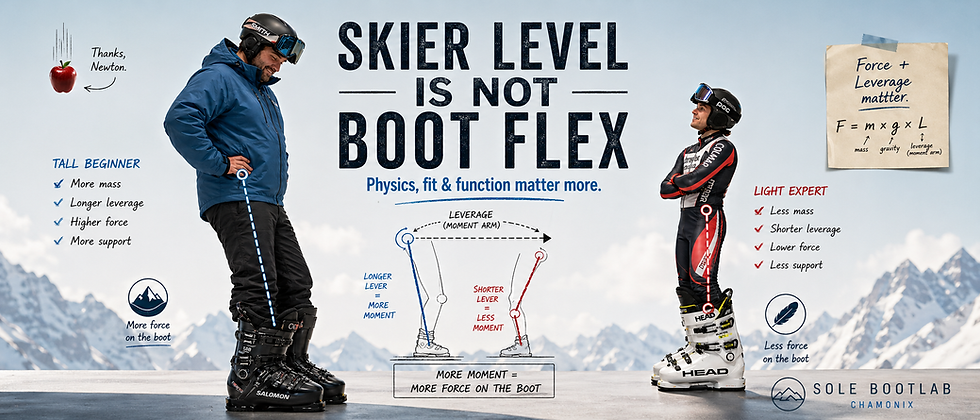
A tall, heavy beginner may need more support than a short, light expert skier. That is not opinion. That is mechanics.
Force, mass and leverage do not wait politely for your ski level to improve before they start existing.
Newton does not care whether you are a beginner, expert, local hero or ex-racer.
Force is force.
Leverage is leverage.
Gravity is why you are not floating around the room while reading this.
Quick answer
Skier level is useful information, but it should not decide your ski boot flex on its own.
Your boot needs to match your body, strength, weight, height, ankle mobility, stance, confidence, skiing speed, terrain and goals.
A powerful beginner may need more support.
A light expert may need less stiffness than expected.
A better boot is not always about ego. Higher-flex boots often use better materials, better liners, better buckles, better construction and more consistent behaviour.
The real question is not:
“Am I good enough for this boot?”
The real question is:
“Can this boot work properly for my body and my skiing?”
The boot does not know your skier level
A ski boot does not know what level you wrote on a form.
It only responds to mechanical input.
How much force do you put into the boot?How much leverage do you create?How does your ankle move?How does your lower leg sit inside the cuff?How does your foot fill the shell?How fast do you ski?How much support do you need?
That is what the boot feels.
Not your ego.
Not your ski school badge.
Not your Instagram caption.
A 100 kg beginner who is tall, strong and athletic can overload a soft boot very quickly.
A 55 kg expert skier may be technically excellent but not generate the same force into the shell.
The beginner may need support.
The expert may need precision.
Those are not always the same thing.
Beginner does not mean weak
One of the big mistakes in ski boot advice is treating “beginner” as if it means weak, fragile or mechanically irrelevant.
A beginner could be a 50 kg cautious adult, a 95 kg ex-rugby player, a 190 cm strong athletic person, a nervous first-timer, or someone committed to progressing quickly.
These people are all “beginners” on paper.
Mechanically, they are completely different.
If a tall, heavy beginner is put into a boot that is too soft, they may collapse through it. The boot may not hold them in a stable position. They may struggle to pressure the ski correctly. They may feel vague, unstable and tired.
In that case, a better, more supportive boot can actually make learning easier.
Not because the beginner is secretly an expert.
Because their body needs support.
Support is not only for elite skiers.
Support is for bodies that need support.
Expert does not mean maximum stiffness
The opposite mistake happens with expert skiers.
People assume that if you ski well, you must need the stiffest possible boot.
Not always.
A small, light, technically excellent skier may not need an extremely stiff boot. Good technique often means efficient movement. They may not need to smash the boot to make it work.
If the boot is too stiff for their body, it may block ankle movement, reduce feel, increase fatigue and make the skier work harder than necessary.
Expertise does not automatically equal 130 flex.
A good skier does not need to prove anything by suffering in a boot that does not move.
That is not performance.
That is a cock-measuring contest with buckles.
Higher flex often means better construction
Higher-flex boots are often treated as if they are only for better skiers.
Beginner boots are usually cheaper and softer.
Expert boots are usually more expensive and stiffer.
So people start thinking:
“I am not good enough for that boot.”
But that misses something important.
Higher-flex boots are often not just stiffer. They are often simply better built.
They may use better plastics, better liners, better buckles, better straps, better pivots, better boot boards, stronger shell construction and more precise fittings.
They are often more durable, more consistent, more predictable and more supportive.
That matters for all skiers.
A beginner can benefit from better construction.
An intermediate can benefit from better support.
A heavy or tall skier may need better materials simply because they generate more force.
A committed skier who wants to progress may be better served by a boot that remains accurate and supportive, rather than one chosen only because a chart said “beginner.”
The question is not:
“Are you good enough for this boot?”
The better question is:
“Can this boot work correctly for your body?”
Better boots are not about ego
Let’s be fair to expert skiers.
There is a reason passionate skiers care about better boots.
It is not always vanity.
Better boots can give better feedback, better snow feel, better precision, better support, better durability and a more consistent connection to the ski.
If you ski a lot, ski fast, ski aggressively, ski technical terrain or simply care about the quality of the experience, wanting a better boot is not fake.
But it becomes nonsense when the number becomes the identity.
“I ski a 130.”
Congratulations. Shall we put it on your tombstone?
A 130 flex boot is not a personality.
It is not a moral achievement.
It is a tool.
If it works for your body, your skiing and your goals, excellent.
If it does not, it is just an expensive plastic prison.
Flex is not just stiffness
The flex number on a boot is useful.
But it does not tell the whole story.
A boot’s real behaviour depends on the model, plastic, shell design, liner, cuff height, boot board, buckle tension, temperature, skier body and stance.
Two boots marked with the same flex can feel completely different.
A boot can be stiff but harsh.
A boot can be stiff but smooth.
A boot can be supportive without feeling dead.
A boot can feel soft in the shop but powerful on snow.
So when someone says, “I need a 120,” or “I ski a 130,” we understand what they mean.
But the real question is:
Does this exact model work for this exact skier?
That is the conversation that matters.
The right boot is not the most expensive boot
Saying higher-flex boots are often better built does not mean everyone should buy the stiffest, most expensive boot in the shop.
That would be stupid.
A boot still has to match the skier.
If you cannot move in it, it is wrong.
If it blocks your ankle, it is wrong.
If it puts you in a bad stance, it is wrong.
If it crushes your foot so badly that you ski like a hostage, it is wrong.
A high-quality boot that does not work for you is still the wrong boot.
A lower-flex boot that works correctly is better than a high-flex boot chosen for vanity.
The aim is not to buy stiffness.
The aim is to buy function.
Final thought
Choosing ski boots by skier level alone is lazy.
It is easy for charts, rental forms and online shops.
But it is not accurate enough for real bootfitting.
A tall, heavy beginner may need more support than a short, light expert skier.
A passionate expert may be right to care about better materials, better liners, better buckles and more consistent flex.
A beginner should not be denied quality because they are new.
An expert should not use stiffness as a personality test.
The boot does not care what level you call yourself.
It cares about force, leverage, movement, fit and function.
That is physics.
And physics is rude, but reliable.
At Sole Bootlab in Chamonix, we choose ski boots by looking at the skier, not just the label.
Because the goal is not to match your ego to a number.
The goal is to help you ski better.
Comments