
How Do I Get My Ski Boots to Flex Properly?
Updated: Apr 29
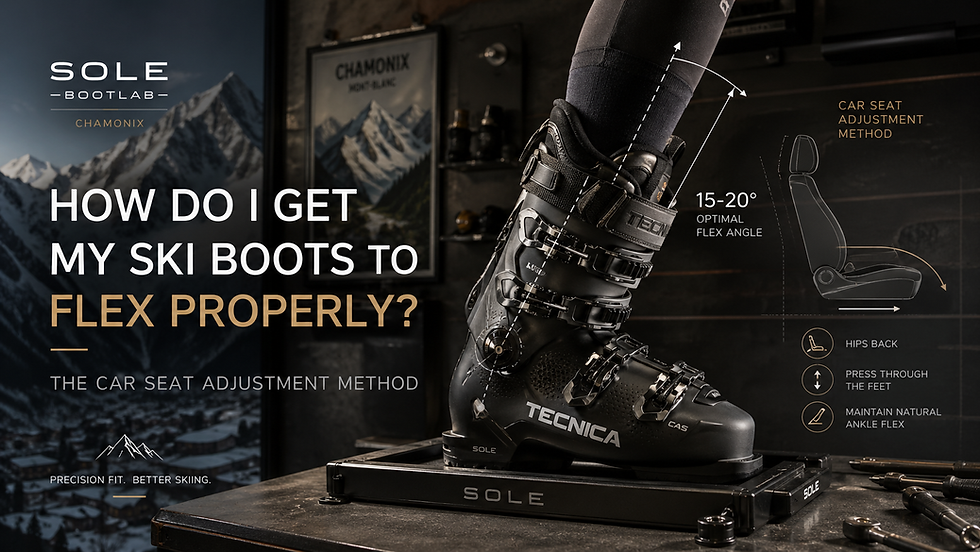
The car seat adjustment method
Most skiers think ski boot flex is simple.
You look at the number printed on the side — 100, 110, 120, 130 — and assume that tells you how stiff the boot is.
Too stiff? Go softer.Too soft? Go stiffer.Can’t flex the boot? Blame the number.
Nice and tidy.
Unfortunately, ski boots are not tidy. They are strange plastic machines attached to complicated human beings. That is where the fun begins.
At Sole Bootlab in Chamonix, we look at boot flex differently.
A boot does not flex properly just because it has the “right” number printed on the cuff. It flexes properly when the skier is positioned correctly inside it and can access the range of movement the boot is designed to work through.
The easiest way to explain this is with something familiar:
driving a car.
Before you drive, you adjust the seat. You move closer to or further from the pedals. You change the backrest angle. You check whether your knees, hips, shoulders and arms are in the right position.
The car has not changed.
But your ability to control it has changed completely.
Ski boots work in a similar way.
Quick answer
If your ski boots feel impossible to flex, the flex number might be wrong.
But it might not be.
The problem may be your position inside the boot: your foot, ankle, lower leg, cuff angle, boot board, liner, footbed and stance all affect whether you can access the boot’s flex properly.
Good flex is controlled movement. You move into the boot, feel support, pressure the ski and return to centre.
A ski boot should not feel like a brick wall.
It should not feel like wet cardboard either.
The car seat problem
Imagine trying to drive with the car seat too far back.
You can touch the pedals, but you cannot press them properly. Your movement is weak and late.
Now move the seat too close.
You are cramped. Your knees are jammed. You can move, but not well.
Now recline the backrest too far.
You are behind the controls. You can drive, but you are not properly connected to the car.
Nothing is wrong with the car.
The problem is the relationship between your body and the controls.
That is exactly what happens in ski boots.
If your foot, ankle and lower leg are not positioned correctly, the boot may feel too stiff, too soft, too upright, too aggressive, too vague or completely dead.
The boot might be wrong.
But the setup might also be wrong.
Those are not the same problem.
Flex is not just a number
The flex number printed on a ski boot is useful, but it is not a universal scientific measurement.
A 120 flex label does not tell us exactly how that specific boot model will behave through a real range of movement. It gives a general indication, not a complete answer.
And this is not really about the brand name on the shell.
It is about the model.
Two different boot models from the same manufacturer can behave very differently because of plastic, cuff height, shell architecture, hinge position, liner, closure system, wall thickness and intended use.
So the question is not:
“Is this brand stiff or soft?”
The better question is:
“How does this exact boot model behave under this skier, in this position, through this range of movement?”
Less sexy, perhaps.
More useful.
Science does have terrible marketing sometimes.
Proper flex measurement needs context
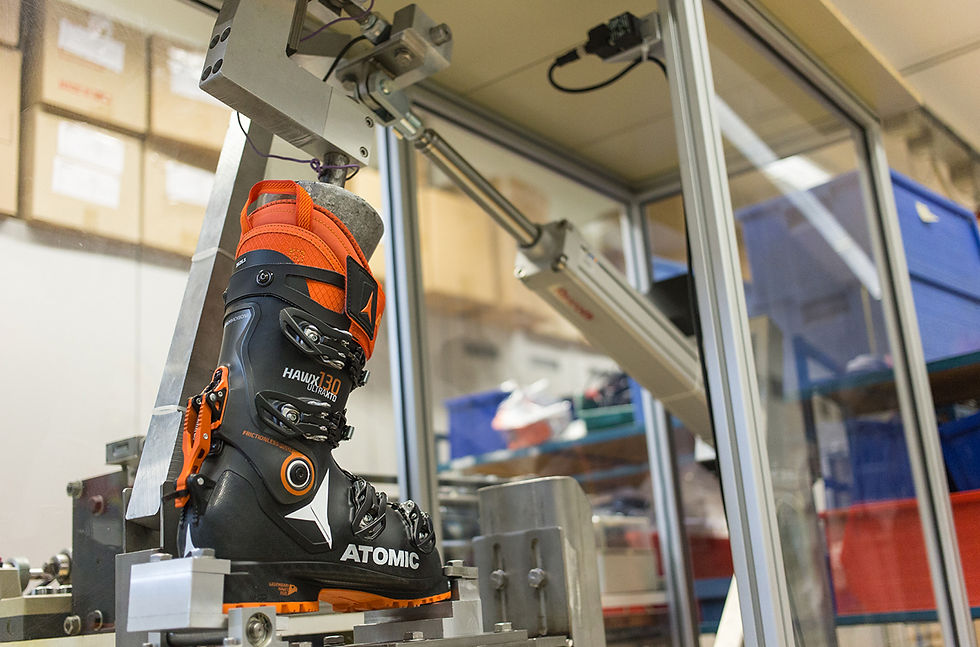
In theory, ski boot flex should be measured as torque: Newton-metres, or Nm.
That part is universal.
But a flex result only means something if we know the test conditions.
At minimum, we need:
Temperature — plastic changes behaviour with temperature.
How the boot is filled and tensioned — a boot does not flex the same empty as it does with a liner, foot, lower leg, buckles and power strap.
The exact angle being measured — flex is not one fixed thing. We need to know the start angle and end angle of the test.
Without those details, a “flex number” is not a proper mechanical measurement.
It is more like a label.
Useful? Yes. Complete? No. Worth building your entire boot choice around? Absolutely not.
The ankle matters
Nobody walks into the shop saying:
“I’d love to discuss my dorsiflexion today.”
Which is a shame, because ankle movement is one of the keys to whether a ski boot actually works.
Dorsiflexion is the movement where your shin moves forward over your foot. In skiing, you need enough of it to stand in the boot, move into the cuff and pressure the ski without collapsing somewhere else.
But ankle movement changes depending on what your knee is doing.
You may look mobile in one position and restricted in another.
That matters because the boot has its own geometry. Boot board angle, heel height, cuff forward lean, liner position and binding setup all affect how your ankle and lower leg sit inside the system.
If the boot uses up too much of your available ankle movement before you even start skiing, the boot can feel like a wall.
That is when skiers say:
“I can’t get forward.”“I can’t flex the boot.”“I feel stuck in the back seat.”“My quads are burning.”
Sometimes the answer is not a softer boot.
Sometimes the answer is adjusting the relationship between the skier and the boot.
Why we do not choose boots from a chart
A chart can tell you flex, last width, weight and intended use.
It cannot see your ankle.
It cannot see your calf.
It cannot see how your heel sits.
It cannot see whether your foot collapses.
It cannot see whether your stance is using up all your movement before you even start skiing.
That is why the “best boot” is not just the boot with the best review.
The best boot is the one that works with your foot, your ankle, your lower leg, your skiing and the modifications needed to make the whole system function.
Final thought
If your ski boots feel impossible to flex, the flex number might be wrong.
But it might not be.
The real problem may be the relationship between your ankle, leg, foot and the boot’s geometry.
Like a car seat, a ski boot has to put you in the right position before the controls make sense.
At Sole Bootlab, we do not look at ski boot flex as one isolated number.
We look at the whole system.
Because the goal is not just to make the boot flex.
The goal is to make you ski better.
Comments