
How to Choose the Right Skis: The Wheel Has Already Been Invented

Why choosing the right ski shouldn't be complicated.
Every winter the ski industry appears to discover another revolutionary way of attaching two long, narrow objects to our feet and sliding down a mountain. We get new constructions, new materials, new categories and an extraordinary amount of discussion about the supposedly transformative differences between products that, in many cases, are attempting to accomplish remarkably similar things.
I'm not suggesting ski technology hasn't progressed. Quite the opposite. Materials science, manufacturing techniques, ski geometry and our understanding of how skis behave have all developed considerably over the years. Much of that progress is genuinely impressive, and we've been fortunate enough to see some of it happening from inside the industry.
What I question is whether the increasingly elaborate language used to describe skis has made choosing them any easier, or whether we've simply become very good at complicating something that ought to be relatively straightforward.
After years of testing skis, working with manufacturers, visiting factories and fitting equipment to an enormous variety of skiers, I've come to believe that the fundamentals are rather less mysterious than we're often encouraged to think.
We still have a skier, two skis, gravity and snow. Gravity, incidentally, remains entirely indifferent to what the marketing department has called this year's collection.
How to Choose the Right Skis:
Start with the Manufacturer
Our approach begins before we consider the individual models in a manufacturer's catalogue. We start with the companies that design and manufacture the equipment, because we're interested in something that receives surprisingly little attention in most ski discussions: the consistency of the finished product.
Over the years we've visited and spent time in almost all the major ski-manufacturing facilities, alongside testing skis on snow and working with people involved in their development. Those experiences have been enormously valuable, not least because they reveal the distinction between designing a ski with particular mechanical characteristics and producing that design consistently in a factory.
They're two quite different challenges.
A modern ski is a composite structure assembled from materials with different mechanical properties. Cores, reinforcements, adhesives, edges, bases and other components must be manufactured and combined within controlled processes. Material variation, component placement, temperature, pressure, curing and finishing can all influence the properties of the completed ski.
The engineering challenge isn't simply to arrive at a desirable combination of longitudinal stiffness, torsional rigidity, geometry and damping. It's to reproduce those characteristics consistently across production, and particularly between the two skis that will eventually be sold together.
Perfectly identical skis are an unrealistic expectation. Manufacturing tolerances exist precisely because some variation is inevitable, but the size and control of that variation matter.
We want to be as confident as reasonably possible that the skis a customer receives behave as the designers intended, and that one ski doesn't respond significantly differently from its partner under comparable loading.
This is why our selection process places such importance on manufacturing quality, production control and testing. We favour companies whose engineering methods and production standards give us confidence in the products we put in front of customers.
It's also why we have little patience for the romantic mythology sometimes surrounding boutique ski brands. A small manufacturer is not inherently superior because its production is limited, handmade or accompanied by an interesting story. Equally, a large manufacturer isn't automatically better because it has sophisticated equipment and substantial resources.
Excellent and poor manufacturing are possible at either scale. The question is whether the producer has the engineering competence, processes and quality control to deliver its intended design consistently.
We've no particular interest in selling exclusivity for its own sake. Good engineering is considerably more interesting to us.
A Ski Doesn't Know How Good You Are
One of the more persistent habits in the ski industry is dividing customers into beginner, intermediate, advanced and expert categories, then attempting to assign equipment on that basis.
I've never found this especially convincing.
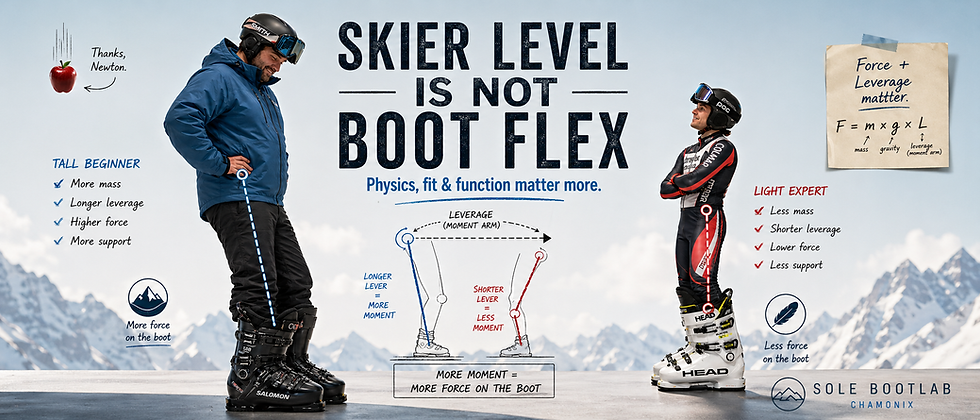
These classifications can offer a rough description of someone's experience or technical ability, but they're woefully inadequate as mechanical specifications. A ski doesn't know which category its owner belongs to. It responds to forces, changes in loading, geometry and its interaction with the snow.
Consider two technically accomplished skiers. One weighs 95 kg, enjoys skiing quickly and actively generates substantial pressure through the skis. The other weighs 65 kg, prefers moderate speeds, shorter turns and a rather less energetic approach. Both might be excellent skiers, yet their physical requirements and the behaviour they want from their equipment could be entirely different.
We can reverse the example. A relatively inexperienced skier who is physically large and strong may generate greater loads than a far more technically competent skier of considerably smaller stature. That doesn't mean technique is irrelevant, because how those forces are applied is obviously important, but it demonstrates why an ability label tells us so little on its own.
And there's another distinction that I think gets overlooked. Being capable of skiing demanding equipment doesn't necessarily mean you want to spend an entire day doing so.
Some people enjoy working their skis hard, producing pressure and feeling the resistance and response of a strong construction. Others, including very accomplished skiers, prefer equipment that requires less physical input and allows them to change direction, adapt to terrain or simply relax.
Neither preference is evidence of greater or lesser ability.
We therefore place considerably more importance on a skier's height, weight, physical characteristics, technique, preferred speed, intended terrain and the way they actually want to engage with their equipment.
A ski isn't a badge of achievement, and selecting a more demanding model shouldn't be treated as a promotion.
Length, Width and the
Rather Inconvenient
Laws of Mechanics
For all the technology involved in modern ski construction, the basic dimensional considerations remain fairly straightforward. We have length, width, sidecut and profile, combined with the mechanical characteristics of the materials and construction.
They interact to determine how the ski behaves, which is why selecting equipment through a single measurement or a convenient classification is rarely sensible.
Length is a good example. The traditional approach of selecting a ski according to somebody's height, then adding or subtracting a few centimetres based on their declared ability, is a rather crude approximation.
A skier's mass, physical strength, skiing speed, technique, preferred turn shape and intended snow conditions all influence what constitutes an appropriate length. So does the ski's own geometry and construction.
Longer skis generally offer more surface area and potential support in soft snow, along with different stability and running-length characteristics. Shorter skis may be easier to pivot or manoeuvre in certain conditions, but reducing length also changes the way the ski distributes load and interacts with the snow.
Neither characteristic is universally desirable. What matters is understanding the consequences of the choice.
Width deserves similar consideration. On firm snow, a narrower waist generally permits more direct edge-to-edge movement and changes the leverage involved in establishing edge angle. As the snow becomes softer and deeper, additional surface area becomes increasingly useful for flotation and support.
This seems reasonably obvious, yet we regularly encounter combinations of ski length and width that make us wonder what the original objective was.
If somebody chooses a very wide ski principally for flotation, why automatically reduce its length to the point where much of the additional surface area and support is lost?
There can be perfectly legitimate reasons for choosing a relatively short, wide ski. Manoeuvrability, terrain, construction and individual preference all have their place. But the combination should be selected deliberately, rather than because a sizing chart assumes everyone will find a shorter ski easier.
A heavy skier using a very short ski with an enormous waist may end up with an awkward compromise: increased width and the mechanical consequences that accompany it, without sufficient length for the support, stability or flotation they're actually seeking.
It isn't that every short, wide ski is wrong. It's that the dimensions need to make sense together, and the explanation ought to be better than somebody in a shop announcing that it's this year's recommended size.
Construction Matters,
but More Demanding
Doesn't Mean Better
Two skis of similar dimensions can behave quite differently, even when their published specifications appear close.
Longitudinal stiffness, torsional rigidity, the distribution of those properties along the ski, mass, damping, rocker and camber all influence how the ski responds to loading and changes in direction. Sidecut and effective edge further influence how it interacts with the snow, particularly when edged and pressured.
These characteristics are important, and good manufacturers devote considerable effort to getting them right.
What I find less useful is the assumption that a skier should automatically progress towards stiffer, heavier or more physically demanding equipment as their technique improves.
A stronger construction may offer the response, support and stability sought by someone who regularly skis with substantial physical input. Equally, it may prove cumbersome or tiring to someone who prefers a less aggressive approach.
A lighter, more accommodating ski can make changes of direction easier, provide a more playful feel and demand less effort in certain situations, but that doesn't make it inherently suitable only for beginners or less capable skiers.
There are always compromises, and they change according to the skier and the conditions.
The question shouldn't be how much ski somebody is good enough to manage. It should be what response they want from their equipment, and whether the chosen construction provides it.
I suspect a fair number of skiers would enjoy their days considerably more if they stopped treating their skis as something they needed to prove themselves worthy of.
What Years of Ski Testing
Have Taught Us
We've spent years testing skis, often comparing equipment across different constructions, dimensions and intended uses. We've also had opportunities to work alongside manufacturers and gain a better understanding of why particular design decisions were made.
Testing is enormously useful, but it has also made me wary of the certainty with which some ski reviews describe small differences between products.
A skier's impressions are influenced by considerably more than the ski model. Snow conditions, preparation, tune, ski length, bindings, boots, fatigue, familiarity and expectations can all alter the experience. Even changes in where and how somebody applies pressure can produce a markedly different result.
That doesn't make subjective impressions worthless. Quite the opposite: how equipment feels to the person using it is ultimately a very important part of choosing it.
But personal impressions are not universal mechanical truths.
I've read countless descriptions of skis as powerful, damp, lively, forgiving, precise, intuitive or demanding. These terms can be useful when they are properly explained and related to the circumstances in which the observations were made. On their own, however, they often tell us rather less than their authors imagine.
A ski that feels exceptionally stable to one person may feel reluctant to change direction to another. Something described as playful may simply respond to smaller inputs, while another skier may prefer the resistance and feedback of a stronger construction.
Both observations can be valid without establishing that either ski is objectively better.
Dedicated racing equipment and lightweight, uphill-focused touring skis sit at more specialised ends of the design spectrum, where particular performance requirements can impose quite substantial differences in construction and behaviour.
Across the broad middle ground of recreational alpine skiing, however, there is often far more overlap between products than marketing descriptions would have us believe.
This doesn't mean all recreational skis are the same. They're not. It means the differences need to be considered in proportion, with an understanding of the mechanics, rather than treated as astonishing discoveries every time somebody tests a new topsheet.
The more equipment we've tested, the less convinced I've become that an enormous catalogue of overlapping models makes choosing a ski any easier.
Why We Deliberately Limit
Our Ski Selection
From a retailer's perspective, offering a huge variety of equipment can look impressive. It's also easy to justify: more models apparently mean more opportunities to find something appropriate.
But variety is only useful when it offers meaningful differences.
We prefer to begin with manufacturers we have confidence in, then select a relatively small number of ski families with recognisably different mechanical characteristics. Within those families, we choose widths suited to different terrain and snow conditions, and then establish appropriate lengths for the individual skier.
The objective is not to stock every possible interpretation of a freeride, all-mountain or piste-oriented ski. It's to provide sufficient genuinely different options to make a sensible choice.
There are three broad considerations behind that decision: the quality and consistency of the manufacturing, the way the skier wants the ski to respond, and the dimensions appropriate for the skier's physical characteristics and intended conditions.
That is a much more useful conversation than asking somebody to rate their skiing ability out of ten.
It also makes it easier for us to explain why we're recommending a particular product and, equally importantly, why we might advise against another.
Our Current Example:
The SOLE 3×3 Selection
For winter 2026/27 we've applied this approach to three ski families, each available in three waist widths. Nine models intended to cover an exceptionally broad range of recreational alpine skiing, excluding dedicated race skis and lightweight, uphill-focused touring equipment.
The Armada Antimatter, available in 100, 108 and 114 mm widths, represents the most physically demanding end of our current selection. Its stronger construction and comparatively longer turning radii suit skiers who enjoy actively loading their equipment, maintaining speed and working the ski through committed turns.
The Nordica Unleashed, in 98, 106 and 114 mm widths, occupies the middle ground. It retains considerable stability and performance potential but offers a more accommodating character, allowing the skier to engage dynamically when desired without requiring the same degree of continuous physical commitment.
The Blizzard Canvas, in 100, 108 and 118 mm widths, provides a lighter-feeling, more playful alternative. Its relatively shorter turning radii and more accessible response favour easier changes of direction and a less physically demanding relationship with the ski.
These descriptions are comparisons within our current selection, not universal definitions of the three manufacturers. The precise differences depend on model, length and conditions, as they always do.
Nor do these three families represent a hierarchy of skiing ability. An exceptionally competent skier may prefer the Canvas, just as another skier may find the more demanding character of the Antimatter particularly enjoyable.
Once we've established the character that suits the individual, we can consider the width and length appropriate for their physical dimensions, intended terrain and typical snow conditions.
The nine skis are not an attempt to suggest that everything else on the market is inferior. They're the result of a deliberately selective approach to equipment retail.
Next year's choices may be different. The engineering principles behind them won't be.
We Can't Reinvent the Wheel,
and There's No Reason to Try
The ski industry contains some exceptionally capable engineers, designers and manufacturing specialists. I've met and worked with enough of them over the years to have enormous respect for the expertise involved, and I would be the last person to dismiss genuine advances in construction or manufacturing.
What I find frustrating is the distance that sometimes develops between that engineering work and the claims used to sell the finished product.
We end up discussing products as though their marketing categories have some fundamental mechanical significance, or assuming that greater stiffness, higher prices, more elaborate materials and supposedly expert-level specifications must necessarily produce a better skiing experience.
Sometimes they might. Often they won't.
We've spent a substantial part of our working lives understanding equipment, examining how it's made, testing how it behaves and trying to establish what actually matters to the person using it. That experience has led us towards a rather uncomplicated philosophy.
Start with manufacturers capable of consistently producing properly engineered equipment. Understand the skier's physical characteristics, technique and preferred level of engagement. Choose a construction and geometry that complement those requirements, then select dimensions appropriate for the intended snow and terrain.
There will always be subtleties, exceptions and interesting engineering compromises to discuss. That's part of what makes the subject enjoyable, and why we're still interested in it after all these years.
But complexity for its own sake isn't expertise, and endlessly multiplying product categories doesn't necessarily help anybody make a better decision.
At SOLE, we aren't particularly interested in selling the most fashionable ski, the most expensive ski or the one supposedly reserved for the most accomplished skier. We're interested in recommending something well manufactured, mechanically appropriate and enjoyable for the person who will actually use it.
We've never claimed to have reinvented the wheel.
Frankly, I think the original was a pretty good idea.
SOLE Bootlab — Chamonix
Engineering, experience and a healthy disregard for unnecessary nonsense.


Comments